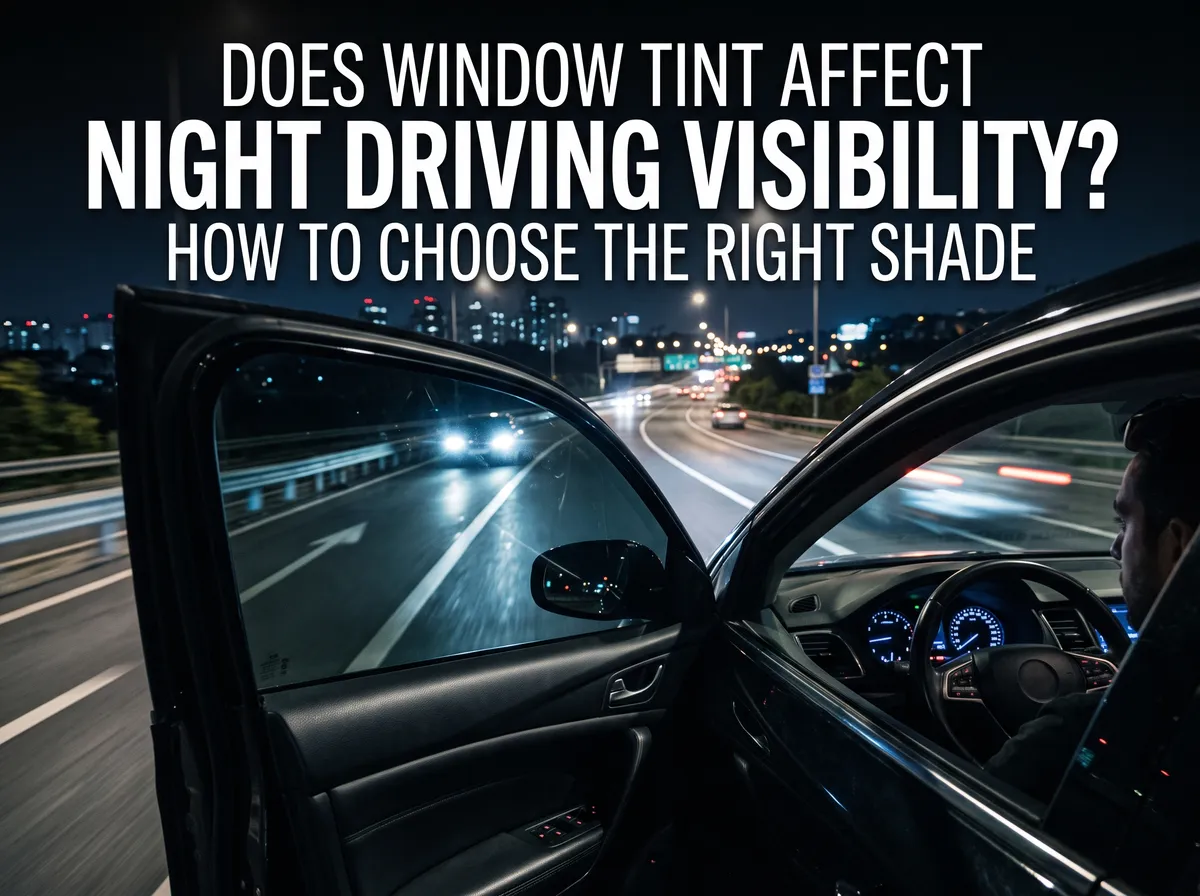
Does Window Tint Affect Night Driving Visibility? How to Choose the Right Shade
Window tint can affect night driving visibility because darker film allows less visible light through the glass.
The effect becomes more noticeable on poorly lit roads, while parking, or when looking through side and rear windows after dark. Choosing the right tint means balancing privacy and glare reduction with enough visible light for comfortable nighttime driving.
Key Takeaways:
• Higher VLT means more visible light passes through the window.
• Dark shades such as 20% and 5% can make low-light visibility more difficult.
• High-performance film can reduce heat without requiring extremely dark glass.
Does Dark Window Tint Make It Harder to See at Night?
Yes. As VLT decreases, less visible light reaches the driver's eyes through the tinted glass.
VLT stands for Visible Light Transmission.
A higher percentage means a lighter film.
A lower percentage means a darker film. The International Window Film Association notes that a 70% film appears nearly clear, while a 15% film appears almost black from outside and can be difficult to see through.
A simple comparison:
These descriptions are general guidance. Actual visibility also depends on factory glass, road lighting, weather, eyesight, and the position of the tinted window.
Premier Window Tinting specifically notes that darker tint can reduce nighttime visibility and recommends drivers who frequently travel after dark avoid going excessively dark.
This matters most when you need to see through side glass.
Examples include:
• Turning onto an unlit street
• Checking for pedestrians
• Reversing at night
• Parking in dark areas
• Checking side mirrors through tinted windows
• Driving on poorly illuminated roads
If night driving is common for you, visibility should carry more weight than maximum privacy.
Premier's guide to Visible Light Transmission and choosing the right tint explains the differences between common VLT percentages in more detail.
What Tint Percentage Is Best for Night Driving?
For drivers focused on nighttime visibility, lighter films generally provide the easiest view through the glass.
There is no single ideal percentage for every vehicle.
A useful way to compare common shades is:
70% VLT
A 70% film looks close to clear.
It allows substantial visible light into the vehicle while quality films can still provide solar-control benefits.
This is useful for drivers who prioritize visibility over privacy.
50% VLT
A 50% film adds a mild shaded appearance without dramatically darkening the cabin.
For drivers who spend significant time on dark roads, 50% can provide a practical balance between a tinted appearance and nighttime visibility.
35% VLT
A 35% film provides noticeably more privacy.
Premier describes 35% as a balance between shade, privacy, and visibility. However, its use must still comply with the rules applying to the specific window being tinted.
20% VLT
At 20%, the glass becomes substantially darker.
This shade can work well for privacy on legally eligible rear windows, but nighttime visibility through those windows will be lower.
Drivers who frequently reverse or maneuver in dark areas should consider this tradeoff carefully.
5% VLT
Five-percent film is often called limo tint.
It provides extreme privacy but allows only a small percentage of visible light through. Premier warns that 5% film can significantly reduce visibility in low-light conditions.
For frequent night driving, choosing the darkest available shade simply for appearance can create an unnecessary compromise.
Do You Need Dark Tint to Reduce Heat and Glare?
No. Tint darkness and heat rejection are not the same thing.
This is one of the most important factors when choosing film for a daily driver.
A high-quality automotive film can provide heat rejection while remaining relatively light.
The International Window Film Association notes that automotive films can reduce heat and glare, while VLT describes how much visible light passes through the glass.
That distinction means you do not necessarily need 20% or 5% tint to make your vehicle more comfortable.
Premier makes the same point in its VLT guide: film construction and quality can matter as much as darkness for heat control, and high-performance ceramic films can provide significant heat rejection with a lighter appearance.
This approach makes sense for Redwood City drivers who want:
• Better daytime heat control
• Less glare
• Good nighttime visibility
• A subtle appearance
• Reduced reliance on extremely dark tint
Instead of asking only:
“How dark should I go?”
Ask:
“How much heat rejection can I get while keeping the visibility I want?”
That question usually leads to a better everyday driving setup.
You can explore Premier's automotive window tinting options to compare film choices for comfort, heat control, and privacy. Premier states its automotive tinting services target reduced heat and glare in addition to privacy.
What Does California Law Say About Window Tint?
California treats front windows more strictly than rear windows.
Under California Vehicle Code §26708, clear, colorless, transparent material may be installed on the front side windows when the material has at least 88% VLT and the finished window-and-film combination meets the federal 70% minimum light-transmittance requirement, along with the statute's other conditions.
California also allows greater flexibility for side windows behind the driver. Rear-window treatment is permitted when the vehicle meets applicable outside-mirror requirements.
This distinction matters when choosing darker shades.
A percentage that may be suitable for rear glass should not automatically be used on the front doors.
Drivers should also remember that the film's advertised VLT and the final glass-plus-film VLT are not always identical.
Factory glass already affects light transmission.
That is why professional installers measure and consider the complete glazing system.
For a detailed Redwood City breakdown, see Premier's California window tint law guide. The California Vehicle Code should remain the primary legal reference.
FREQUENTLY ASKED QUESTIONS
Q: Is 35% tint hard to see through at night?
A: A 35% tint allows more light through than 20% or 5% film and is commonly viewed as a middle-ground shade. Premier describes it as balancing visibility, privacy, and appearance. However, nighttime visibility varies with road lighting, factory glass, eyesight, and weather. Drivers who spend extensive time on dark roads may prefer a lighter film.
Q: Is 20% tint too dark for night driving?
A: Twenty-percent tint noticeably reduces the amount of visible light passing through the glass. Some drivers are comfortable using it on eligible rear windows, while others find it difficult when parking, reversing, or driving in poorly lit areas. If nighttime visibility is a priority, a lighter shade may provide a better balance.
Q: Does ceramic tint improve night visibility?
A: Ceramic construction does not make a dark VLT automatically easier to see through. VLT still determines how much visible light passes through the glass. The advantage is that high-performance film can provide strong heat control without requiring an extremely dark shade, allowing drivers to select lighter glass while retaining solar-control benefits.
Q: What tint should I choose if I drive at night often?
A: Prioritize a higher VLT and good film performance rather than maximum darkness. Light or moderate film preserves more visible light for nighttime driving. Choose the final percentage based on the window location, California law, factory glass, privacy needs, and your own comfort after dark.
Choose a Tint You Can Live With Day and Night
A tint shade should work after sunset, not only look good during the day.
If you drive frequently at night, prioritize visibility first. Then use film technology to achieve the heat and glare reduction you want without unnecessarily darkening the glass.
Premier Window Tinting has served Redwood City since 1979 and offers automotive films focused on privacy, heat reduction, glare control, and comfort.
Contact Premier Window Tinting to compare VLT options based on your vehicle, driving habits, and desired appearance.
The best tint is not the darkest shade. It is the shade you can see through comfortably when the road gets dark.
