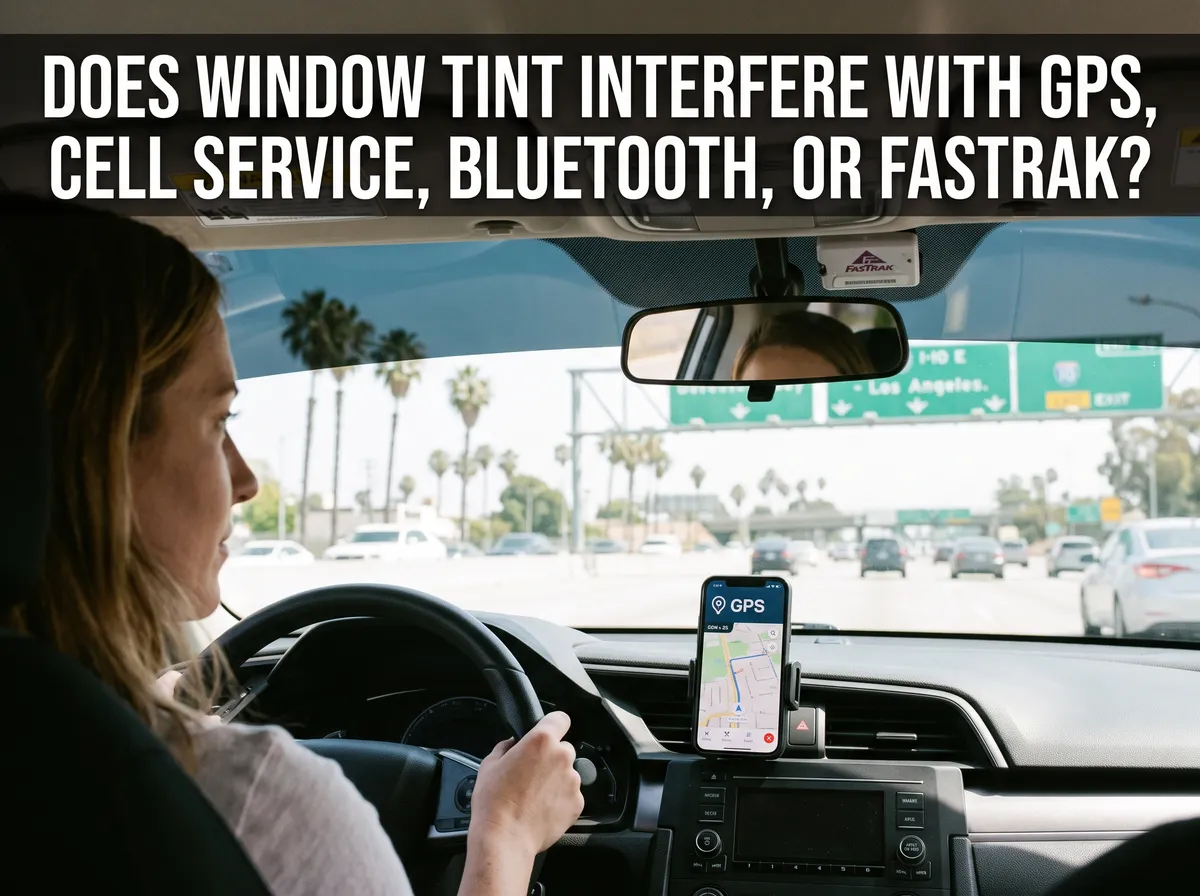
Does Window Tint Interfere With GPS, Cell Service, Bluetooth, or FasTrak?
Window tint can interfere with GPS, cell service, and other wireless signals, but the film material matters far more than the darkness of the tint.
Traditional metallized films contain conductive metal layers that can weaken certain radio-frequency signals. Modern carbon, ceramic, and other non-metallic films avoid this problem while still providing heat rejection, glare reduction, UV protection, and privacy.
Key Takeaways:
• Non-metallic carbon and ceramic films are designed to avoid electronic signal interference.
• Metallized film can weaken GPS, cellular, satellite radio, and other wireless signals.
• FasTrak problems are more likely when metallic materials or specialized windshields interfere with the toll tag.
Why Can Some Window Tint Interfere With Wireless Signals?
Signal interference usually comes from metal in the film, not from the tint being dark.
Some older and traditional window films use microscopic metallic particles or metalized layers to reflect solar energy.
Those materials can also affect radio-frequency signals traveling between the inside and outside of the vehicle.
That can potentially influence technologies such as:
• GPS navigation
• Cellular service
• Satellite radio
• Wireless data connections
• Toll transponders
This is why two films with the same visible darkness can behave differently.
A 35% metallized film and a 35% ceramic film may look similar, but their construction is different.
Modern non-metallic films provide solar protection without creating the same signal concerns.
Premier Window Tinting offers both carbon and IR nano-ceramic automotive films and lists both options as providing no signal interference.
Drivers comparing these technologies can read Premier's guide to ceramic vs. carbon window tint.
For a modern vehicle filled with wireless technology, non-metallic film is usually the simplest choice.
Does Window Tint Affect GPS or Cell Phone Service?
Metallized window film can weaken GPS and cellular reception, while quality non-metallic films generally do not.
GPS depends on radio signals arriving from satellites.
Cell phones also communicate wirelessly with towers outside the vehicle.
Placing conductive metallic material around the cabin can reduce signal strength under some conditions.
This does not mean metallic tint makes a phone or GPS stop working immediately.
The effect depends on:
• How much metallic material the film contains
• Which windows are covered
• Factory glass construction
• Existing signal strength
• Vehicle design
• Antenna location
A driver with strong cellular coverage might never notice a difference.
The same vehicle in a weak-signal area may experience more noticeable changes.
Modern films solve the issue differently.
3M specifically designs multiple non-metallized automotive films to avoid interference with GPS, cellular devices, satellite radio, and 5G connections.
Premier's carbon and IR nano-ceramic options follow the same non-interference approach.
This is particularly relevant for vehicles that rely heavily on connectivity.
Modern cars use wireless signals for navigation, streaming, smartphone integration, traffic information, over-the-air services, and connected applications.
Choosing metal-free film helps preserve those systems without giving up solar performance.
You can compare Premier's available options through its automotive window tinting service.
Does Window Tint Interfere With Bluetooth?
Non-metallic window tint should not interfere with normal Bluetooth operation.
Bluetooth connects nearby devices using short-range radio communication.
In most automotive situations, both devices are already inside the vehicle.
For example:
• Your phone connects to the infotainment system
• Wireless headphones connect to a phone
• A phone connects to an aftermarket stereo
• A digital accessory connects to the vehicle
Because these devices communicate over relatively short distances inside the same cabin, exterior window film is less likely to become the limiting factor.
However, metallic materials can affect radio-frequency transmission generally.
That makes carbon or ceramic film the safer choice for drivers who want to minimize any possibility of wireless interference.
The key distinction remains the same:
Dark tint does not automatically block Bluetooth. Metallic construction is the bigger concern.
A very dark ceramic film can still be non-metallic.
A much lighter metallized film can contain conductive material.
When choosing tint for a technology-heavy vehicle, ask what the film is made from rather than judging it only by shade.
Can Window Tint Interfere With FasTrak?
Certain metallic materials around the windshield can interfere with toll-tag detection.
Bay Area FasTrak normally requires interior toll tags to be mounted correctly on the windshield so roadside equipment can detect them.
FasTrak specifically warns that some vehicles with metal oxide windshields may require an exterior toll tag because the windshield can interfere with communication.
That provides an important clue for window-film selection.
Metal-containing materials placed in the signal path can create problems for radio-based toll systems.
For most drivers using non-metallic carbon or ceramic tint on the side and rear windows, FasTrak interference should not be a concern.
The windshield deserves more attention.
If your toll tag stops reading reliably after a windshield replacement or modification, consider:
• Checking the FasTrak mounting location
• Confirming your windshield construction
• Checking for designated transponder areas
• Verifying whether metallic film is present
• Contacting FasTrak about an exterior toll tag if necessary
FasTrak notes that exterior toll tags may be needed for vehicles with certain metal oxide windshields, flat vertical windshields, or metal structures affecting the windshield area.
Do not assume a missed toll reading means the tint is responsible.
Incorrect transponder placement, windshield technology, account issues, or the toll tag itself may also be involved.
What Type of Window Tint Is Best for Avoiding Signal Interference?
Choose a non-metallic carbon or ceramic film.
These technologies can provide heat reduction without relying on metal layers.
Carbon Window Film
Carbon film provides a balance between performance and price.
Premier lists its carbon automotive film with:
• Up to 50% heat rejection
• 99% UV protection
• Added privacy
• No signal interference
Carbon is a strong option for drivers who want good solar control without moving into the highest-performance ceramic category.
IR Nano-Ceramic Window Film
Ceramic film uses advanced non-metallic particles to manage solar heat.
Premier lists its IR nano-ceramic film with:
• Up to 72% heat rejection
• Improved infrared heat blocking
• 99% UV protection
• Added privacy
• No signal interference
Ceramic makes particular sense for drivers who rely heavily on connected technology while also prioritizing heat rejection.
What About Metallized Tint?
Metallized tint can provide effective solar performance, but signal interference is a potential drawback.
Some film manufacturers explicitly warn that their metalized products may cause slight wireless interference.
That does not make every metallized film unusable.
It does mean modern carbon and ceramic products are often better suited to connected vehicles.
When comparing films, ask:
Is the film metallized?
Is it compatible with GPS and cellular signals?
Will it interfere with satellite radio?
Is it appropriate for vehicles using toll transponders?
What heat rejection does it provide without metal?
For many Redwood City drivers, choosing a quality metal-free product eliminates the signal question before installation.
FREQUENTLY ASKED QUESTIONS
Q: Does ceramic window tint block GPS signals?
A: Quality ceramic window tint should not block GPS signals because it does not rely on metallic layers. Modern ceramic films are specifically designed to provide solar and infrared heat rejection while remaining compatible with GPS, cellular devices, satellite radio, and other vehicle electronics. Film quality still matters, so confirm the specific product specifications before installation.
Q: Can window tint make my cell phone lose service?
A: Metallized window tint can weaken cellular signals in some situations, especially where reception is already poor. Carbon and ceramic films are non-metallic and are designed to avoid this problem. If reliable cellular connectivity matters, ask the installer whether the film contains metal rather than choosing based only on tint darkness.
Q: Will window tint affect Apple CarPlay or Bluetooth?
A: Non-metallic tint should not affect normal Bluetooth connections between devices inside the vehicle. Wireless Apple CarPlay uses wireless technologies within the cabin, so carbon or ceramic film should not create a problem. Metallic film can affect radio-frequency signals generally, which is another reason modern non-metallic films are popular in connected vehicles.
Q: Can ceramic tint stop my FasTrak from working?
A: Non-metallic ceramic tint should not normally interfere with FasTrak. Problems are more likely when metallic materials or specialized metal oxide windshields affect communication between the toll tag and roadside equipment. Correct toll-tag placement also matters. FasTrak offers exterior tags for certain vehicles where windshield construction prevents reliable detection.
Keep Your Car Cool Without Disconnecting It
Today's vehicles depend on wireless technology more than ever.
Window tint should not force you to choose between heat rejection and connectivity.
Carbon and ceramic films provide solar protection without the metal layers associated with potential GPS, cellular, and radio interference.
Premier Window Tinting offers carbon and IR nano-ceramic automotive films in Redwood City, with both options designed to provide heat rejection without signal interference.
Contact Premier Window Tinting to compare film options based on your vehicle, heat-rejection goals, privacy preferences, and technology needs.
Choose tint based on what is inside the film, not only how dark it looks.
