Window Film vs. Window Replacement: Which Makes More Sense for Bay Area Homes?
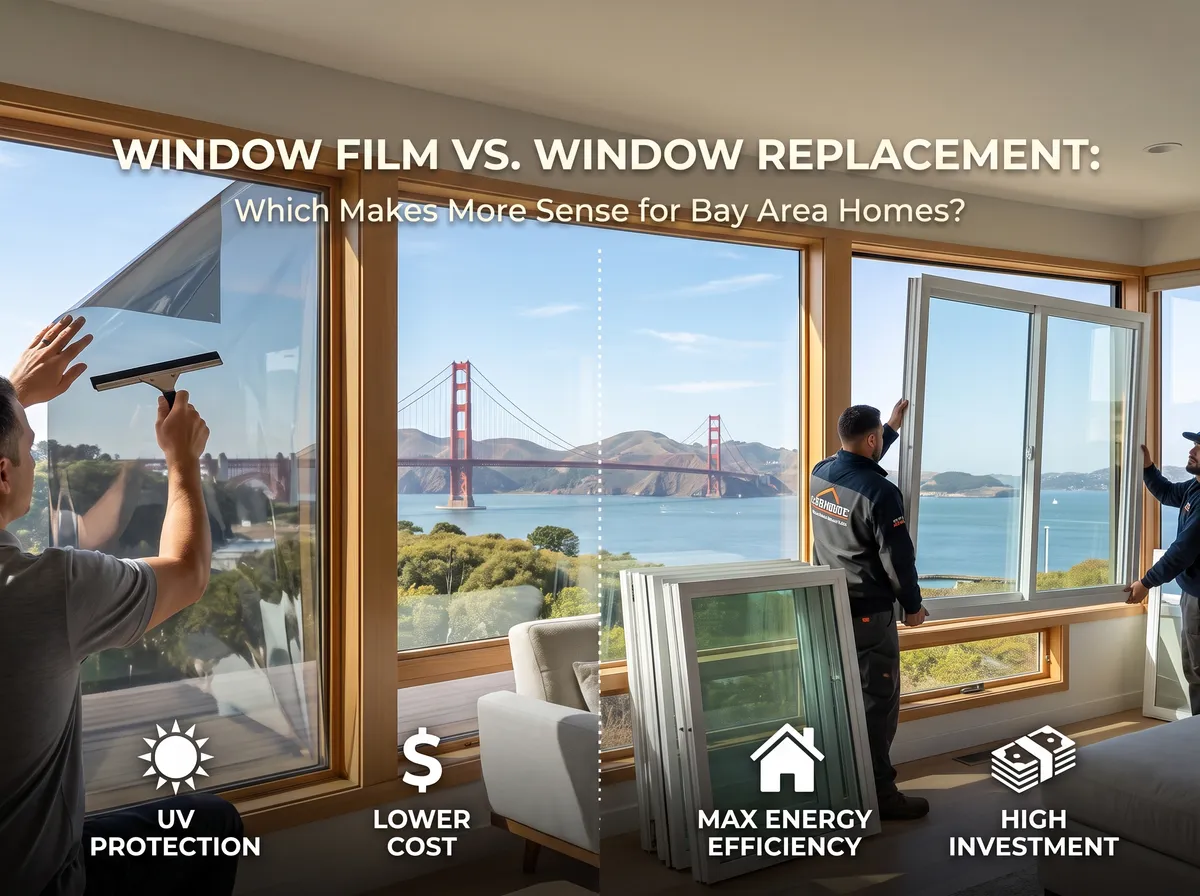
Window film vs. window replacement comes down to one main question: Are your existing windows failing, or do they simply need better solar control?
If the glass and frames are structurally sound, professional window film can often address heat, glare, UV exposure, and uneven room temperatures without replacing the entire window system. If windows leak air, contain failed seals, have damaged frames, or no longer operate correctly, replacement usually makes more sense.
Key Takeaways:
• Window film is usually the lower-cost option when existing windows remain in good condition.
• Replacement addresses problems that film cannot fix, including damaged frames, failed seals, drafts, and broken glass.
• For sunny Bay Area rooms, solar-control film can improve comfort without a full renovation.
When Does Window Film Make More Sense Than Replacing Windows?
Window film makes the most sense when your current windows work properly but allow too much solar heat or glare into the home.
Solar-control film changes how much solar energy passes through existing glass. The International Window Film Association notes that window film can reduce solar heat gain and help lower cooling demand, especially in buildings with significant glass exposure.
For many Redwood City homes, this is the problem.
The windows may open correctly.
The frames may be solid.
There may be no moisture trapped between panes.
The room simply becomes uncomfortable when direct afternoon sunlight reaches the glass.
In that situation, replacing the entire window may solve more problems than you actually have.
Professional residential film can help with:
• Solar heat
• Glare
• UV exposure
• Hot rooms
• Interior fading
• Privacy
• Uneven comfort near large windows
Premier Window Tinting describes solar-control film as a way to reduce heat and glare while helping rooms maintain more stable indoor temperatures during Redwood City heat waves.
Window film also requires much less disruption than replacing the glass, frame, trim, and surrounding finishes.
The International Window Film Association states that residential window film may cost about one-tenth as much as replacement windows in some applications and can often be installed much faster.
That does not mean film is always the better investment.
It means replacement may be unnecessary when the existing window itself is still functional.
Homeowners dealing mainly with direct sunlight can explore residential window tinting options from Premier Window Tinting.
When Is Window Replacement the Better Choice?
Window replacement makes more sense when the problem involves the window assembly itself, not only sunlight passing through the glass.
Film cannot repair:
• Rotten or damaged frames
• Cracked glass
• Failed insulated-glass seals
• Persistent condensation between panes
• Windows that no longer open or close properly
• Serious air leakage
• Structural water intrusion
If those problems exist, adding film does not address the cause.
Replacement also gives homeowners access to modern insulated glazing, better frames, Low-E coatings, and improved air sealing.
ENERGY STAR reports that replacing old single-pane windows with ENERGY STAR certified windows can reduce household energy bills by an average of up to 13% nationwide.
The savings depend heavily on the original window.
Replacing an old single-pane window can produce a larger improvement than replacing a relatively modern dual-pane unit.
That distinction matters.
A Bay Area homeowner with 40-year-old single-pane aluminum windows may benefit substantially from replacement.
A homeowner with functional dual-pane Low-E windows that feel hot only in west-facing rooms may be better served by compatible solar-control film.
ENERGY STAR also notes that window replacement can be expensive, even though upgraded windows can improve household energy performance.
The decision should therefore start with window condition.
If the window is failing, replace it.
If the window works but the sunlight is the problem, consider film first.
Which Option Is More Cost-Effective for Bay Area Homeowners?
Window film is generally more cost-effective when the goal is improving solar performance without rebuilding the entire window opening.
Replacement involves more than glass.
The project may include:
• Removing the old window
• New insulated glass
• New frames
• Installation labor
• Exterior sealing
• Interior trim work
• Painting or finish repairs
Window film uses the existing glass.
That difference explains much of the cost gap.
The International Window Film Association states that film can provide a lower-cost retrofit for structurally sound windows, with installation requiring substantially less time than replacement.
However, lower upfront cost does not automatically mean better value.
Consider the problem first.
Choose Window Film When:
Your windows are in good condition, but rooms become too hot or bright.
Film may provide a targeted improvement without the cost of replacing windows that still have years of useful life.
Choose Replacement When:
Your windows leak, fail, crack, fog internally, or have deteriorated frames.
Spending money on film before solving those problems usually makes little sense.
Consider Both When:
A home contains different generations of windows.
You might replace severely deteriorated units while applying solar-control film to newer windows that only need better heat or glare management.
This mixed approach can be especially practical in older Bay Area homes where previous owners replaced windows gradually.
For homes with functioning dual-pane or Low-E windows, compatibility should always be confirmed before applying film.
Does Window Film Provide the Same Benefits as New Windows?
No. Window film and replacement windows overlap in some areas, but they solve different problems.
Both can improve indoor comfort and energy performance.
The way they achieve those improvements differs.
Window Film Primarily Improves the Existing Glass
Solar-control film can reduce the amount of solar energy entering through the glass.
This makes it particularly useful for rooms affected by direct sun.
The IWFA explains that window film lowers solar heat gain by reflecting or absorbing portions of incoming solar energy before it becomes heat inside the building.
Quality architectural films can also block up to 99% of ultraviolet radiation, helping reduce one contributor to fading of flooring, furniture, artwork, and fabrics.
Replacement Improves the Complete Window System
A new window can address conduction, air leakage, frame performance, glazing performance, and physical deterioration.
Modern ENERGY STAR windows use technologies such as multiple panes, insulated frames, gas fills, and Low-E coatings to improve overall efficiency.
That makes replacement the broader solution.
It is also the more extensive project.
The comparison is therefore not simply:
“Which product is better?”
The better question is:
“Which solution fixes the problem my home actually has?”
For many Redwood City properties with functional windows, adding professional film can be an efficient way to control sunlight without replacing usable glass.
For homes with aging or damaged windows, replacement may provide more complete long-term value.
FREQUENTLY ASKED QUESTIONS
Q: Is window film cheaper than replacing windows?
A: Usually, yes. Window film uses the existing glass and avoids the labor and materials required to remove and replace complete window units. The International Window Film Association states that residential film may cost roughly one-tenth as much as replacement windows in some applications. Actual savings depend on the number, size, type, and condition of your windows.
Q: Can window film make an old window more energy efficient?
A: Window film can improve solar-control performance by reducing heat entering through existing glass. It can be especially useful for sunny rooms and windows with high solar exposure. However, film cannot repair air leaks, damaged frames, broken seals, or failed glass units. Those problems usually require repair or replacement.
Q: Should I replace single-pane windows instead of tinting them?
A: Replacement may make more sense when older single-pane windows also have poor seals, damaged frames, drafts, or significant insulation problems. ENERGY STAR reports that replacing single-pane windows with certified efficient windows can reduce household energy bills by up to 13% on average nationwide. If the windows remain sound and solar heat is the main problem, film may still be worth evaluating first.
Q: Can I tint newer dual-pane or Low-E windows instead of replacing them?
A: Often, yes. If newer dual-pane or Low-E windows remain structurally sound, compatible architectural film may provide additional solar heat or glare control without replacement. The film must match the specific glass system because different glazing configurations absorb and manage heat differently.
Should You Tint or Replace Your Windows?
Start with the condition of the windows.
If the glass, seals, and frames are functioning correctly, but sunlight makes certain rooms uncomfortable, professional window film is often the simpler and more economical option.
If the windows leak, fog, crack, or no longer operate correctly, replacement addresses problems film cannot solve.
Premier Window Tinting has served Redwood City since 1979 and offers residential solutions for heat reduction, glare control, privacy, and UV protection.
Contact Premier Window Tinting to evaluate whether window film makes sense for your existing glass before committing to a larger replacement project.
Good windows do not always need replacement. Sometimes they need better solar control.
