Frosted Window Film vs. Blinds: Which Is Better for Office and Conference Room Privacy?
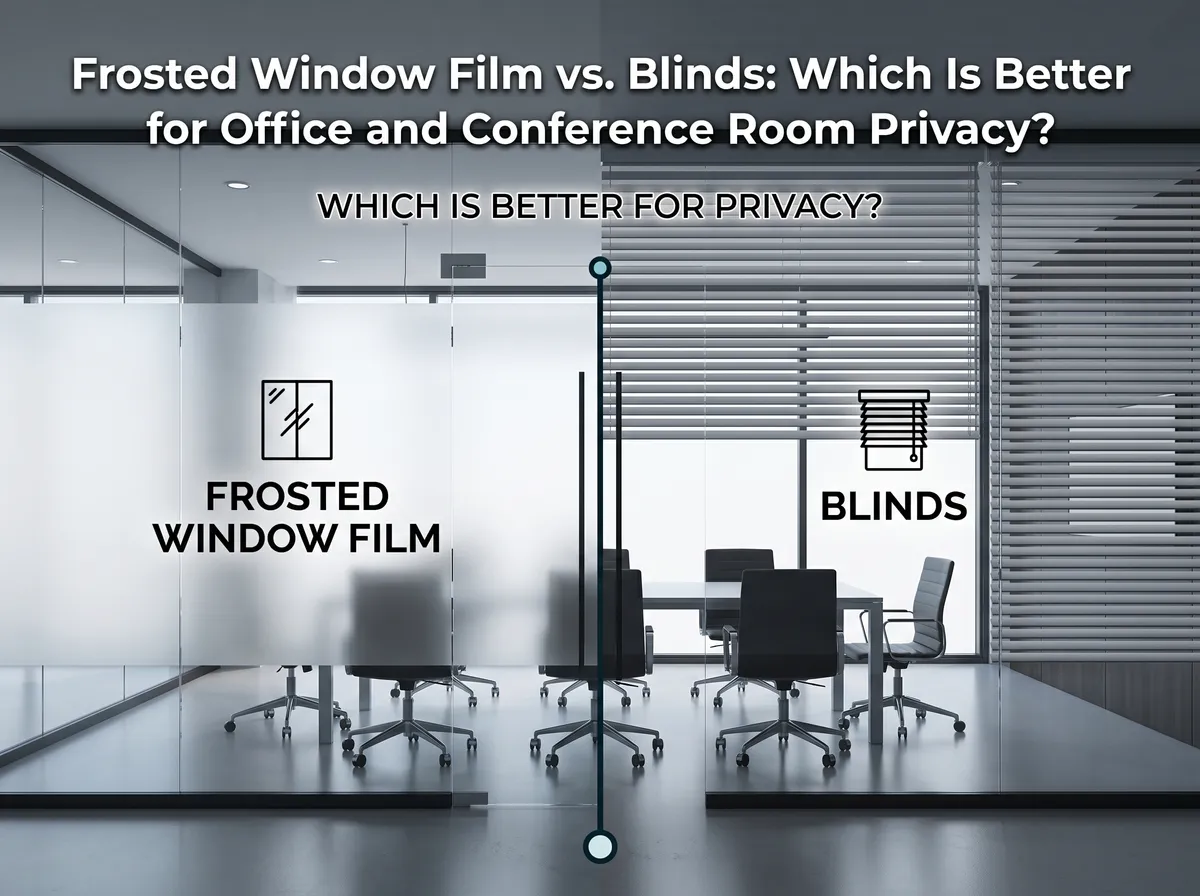
Frosted window film vs. blinds is primarily a choice between permanent visual privacy and adjustable privacy.
Frosted film works well for conference rooms, private offices, clinics, and glass partitions because it obscures views while allowing diffuse natural light through. Blinds are better when employees need to switch between an open view, partial privacy, and complete visual coverage.
Key Takeaways:
• Frosted film provides continuous visual privacy while allowing natural light into the space.
• Blinds provide adjustable privacy but can block daylight when fully closed.
• Conference rooms and glass offices often benefit from full or partial frosted film rather than covering the entire wall with blinds.
Is Frosted Window Film Better Than Blinds for Office Privacy?
Frosted window film is often the better choice when an office needs privacy throughout the working day.
The film attaches directly to the glass and creates an etched, sandblasted, or translucent appearance. 3M offers decorative glass films specifically designed to add privacy while preserving natural light.
Unlike blinds, employees do not need to open or close anything.
That makes frosted film useful for:
• Conference rooms
• Executive offices
• HR offices
• Medical or professional offices
• Glass meeting rooms
• Interior glass partitions
• Reception areas
The International Window Film Association notes that decorative films are available in opaque, patterned, and other privacy-focused finishes for both office and residential applications.
Frosted film also preserves the architectural look of glass walls.
A conference room can remain bright without leaving meetings exposed to everyone passing through the hallway.
Blinds solve the privacy problem differently.
They provide control.
Employees can leave them open during normal work, tilt them for partial screening, or close them when confidential discussions begin.
For spaces where the desired privacy level changes frequently, that flexibility can be valuable.
The main tradeoff is daylight.
When blinds close completely, they can reduce natural light and eliminate the open-glass appearance. The U.S. Department of Energy notes that shades and blinds can be used to control direct sunlight and daylight, but their position directly affects how much daylight enters a space.
For offices that want privacy without continually covering the glass, frosted film generally has the advantage.
Which Option Is Better for Conference Rooms?
For most glass conference rooms, frosted film offers a cleaner balance between privacy and natural light.
A conference room usually needs privacy for presentations, meetings, interviews, and client conversations.
At the same time, completely covering a glass wall can make the room feel enclosed.
Frosted film can obscure people, screens, documents, and visual distractions while allowing light to continue passing between spaces.
There are several ways to use it.
Full Frosted Coverage
The entire glass panel receives frosted film.
This provides the highest level of continuous visual screening.
It works well for HR rooms, medical environments, private offices, and meeting spaces where visibility is rarely needed.
Privacy Bands
Film covers only the center portion of the glass.
The upper and lower areas remain clear.
This can block direct sightlines while keeping more of the transparent architectural design.
Decorative Patterns
Lines, gradients, geometric patterns, or branded graphics can create partial privacy.
3M's decorative glass finishes include frosted, etched, textured, and patterned options intended to add privacy and design to glass surfaces.
Branded Privacy Film
Businesses can incorporate logos, patterns, or visual elements into the privacy treatment.
This turns the glass into part of the office design rather than simply covering it.
For Redwood City offices, professional commercial window tinting can also address glare and solar exposure on exterior-facing glass. Premier states that its commercial solutions are designed to reduce heat and glare while improving workplace comfort and appearance.
One limitation is important:
Frosted film provides visual privacy, not sound privacy.
People outside the room may not be able to see meeting details clearly, but the film does not prevent conversations from being heard.
Sensitive conference rooms may still need acoustic treatment.
What Are the Advantages and Disadvantages of Frosted Film vs. Blinds?
The best option becomes clearer when the two are compared directly.
Frosted Film Advantages
Consistent privacy: The glass remains obscured without employee action.
Natural light: Translucent films can maintain brightness while reducing direct visibility. 3M specifically markets decorative privacy films as a way to customize privacy without sacrificing natural light.
Minimal visual clutter: There are no cords, tracks, slats, or hanging materials.
Design flexibility: Businesses can select etched, frosted, patterned, gradient, or decorative finishes.
Easy use: Once installed, no one needs to remember to close it before a meeting.
Frosted Film Disadvantages
The main disadvantage is that privacy is not adjustable.
If you frost an entire conference room wall, you cannot restore the clear view without removing or replacing the film.
Frosted film can also limit visibility into or out of a room even when privacy is not needed.
This is why partial privacy bands can be useful.
Blinds Advantages
Blinds provide immediate control.
You can open them for visibility and daylight.
You can close them when privacy matters.
They can also help control direct sunlight. ENERGY STAR recommends shades and blinds as one option for managing direct solar gain in commercial buildings.
Blinds Disadvantages
Closed blinds can make glass offices darker.
They also introduce moving components that require adjustment and cleaning.
In offices with many glass partitions, installing blinds across every panel can also change the clean, transparent design that made glass walls attractive in the first place.
How Should Redwood City Businesses Choose Between Film and Blinds?
Start by deciding whether privacy should be permanent or adjustable.
Choose frosted film when:
• Privacy is needed most of the day
• Natural light is important
• The office uses large glass partitions
• A clean, modern appearance matters
• You want logos or decorative patterns
• Employees should not need to operate a privacy system
Choose blinds when:
• Privacy is only occasionally required
• Employees need a clear view at other times
• Full blackout or stronger light control is needed
• The room's purpose changes frequently
Some offices benefit from combining both.
For example, a conference room could use a frosted privacy band across eye level while leaving the rest of the glass clear.
An exterior-facing office could use privacy or solar-control film for everyday comfort and blinds for occasional stronger light control.
Window film can provide benefits beyond privacy on exterior glass.
3M states that commercial building films can reduce solar heat and glare while maintaining views, depending on the selected product.
Premier Window Tinting also offers commercial film solutions for Redwood City businesses seeking improvements in privacy, glare, heat control, and professional appearance.
The best solution depends on what the glass needs to do during a normal workday.
FREQUENTLY ASKED QUESTIONS
Q: Can people see through frosted window film?
A: Frosted film is designed to obscure detailed views through the treated area while allowing light to pass. The exact privacy level depends on the film's opacity, pattern, lighting, and how close someone stands to the glass. For rooms requiring stronger visual privacy, choose a more opaque film and have the product evaluated for the specific space.
Q: Does frosted window film make an office darker?
A: Frosted film changes how light passes through glass, but many products remain translucent and allow significant natural light into the room. This is one of its main advantages over fully closed blinds. Decorative privacy films are specifically available for offices that want visual separation without eliminating daylight.
Q: Is frosted film good for conference room glass?
A: Yes. Conference rooms are one of the most practical applications for frosted window film. Full frosting can provide consistent privacy, while horizontal privacy bands can block direct sightlines without covering the entire glass wall. Decorative patterns can also provide privacy while supporting the office's interior design.
Q: Does privacy window film replace blinds completely?
A: It can when continuous visual privacy is the main goal. However, film does not provide the same adjustable control as blinds. If employees need a clear view one hour and complete visual privacy the next, blinds may be more suitable. Some offices combine film and blinds when they need both everyday privacy and adjustable light control.
Create More Privacy Without Closing Off Your Office
The choice between frosted film and blinds depends on how the space is used.
For conference rooms and glass offices that need consistent privacy, frosted film often provides the cleaner solution.
For rooms where visibility needs to change throughout the day, blinds offer more flexibility.
Premier Window Tinting provides commercial window film solutions for businesses in Redwood City, including options designed around privacy, glare, comfort, and professional appearance.
Contact Premier Window Tinting to discuss your conference room, office partitions, or exterior glass and choose a privacy solution suited to your workplace.
If privacy should always be there, choose film. If privacy needs an on-and-off switch, blinds may make more sense.
